Moment of Truth by Jamie Stern-Weiner
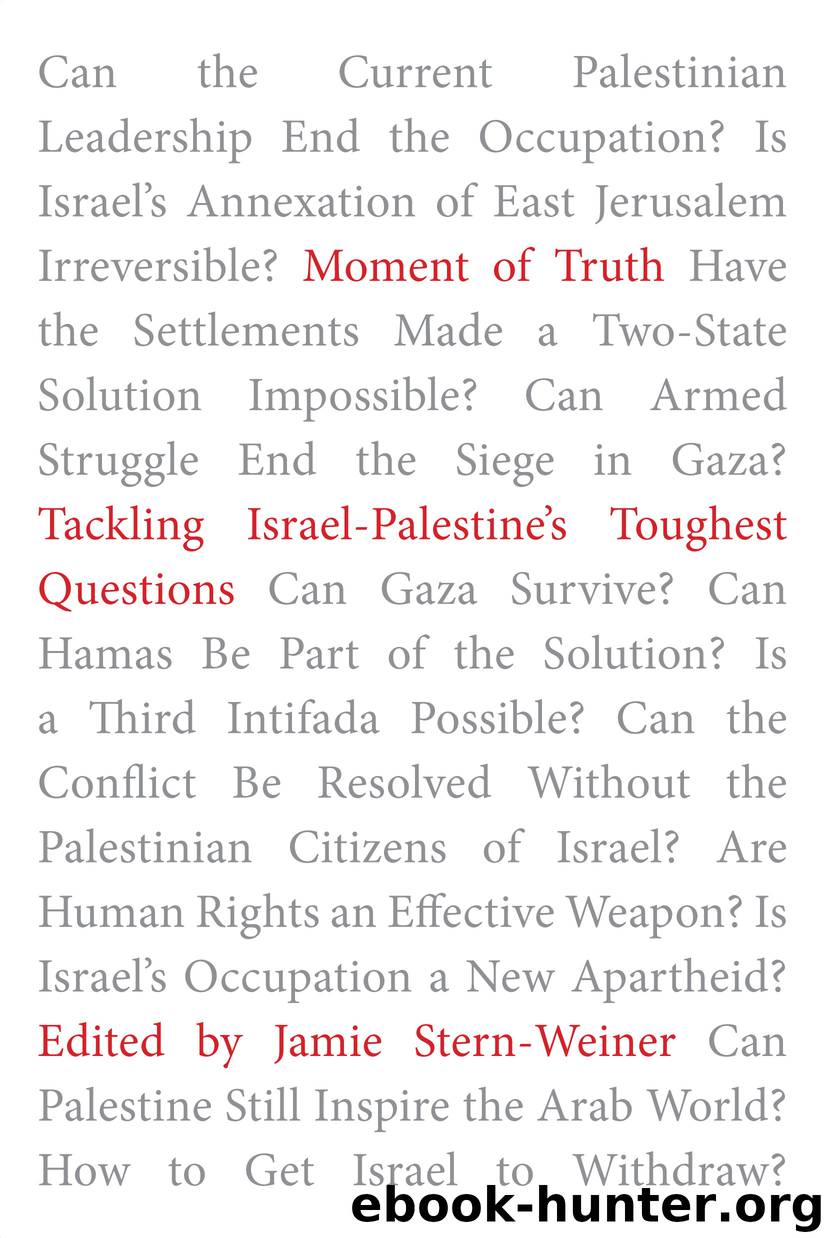
Author:Jamie Stern-Weiner
Language: eng
Format: epub
Tags: General Fiction
Publisher: OR Books
Published: 2018-03-25T04:00:00+00:00
Musa Abuhashhash9
This past year marked the fiftieth anniversary of the occupation of the Palestinian territories by the Israeli army. Did many Palestinians notice? Did they remember the milestones of occupation and resistance—the first intifada, which erupted three decades ago and changed the course of the conflict, or the second intifada which followed? How many Palestinians still think of ending the occupation, or have an appetite for another uprising?
These and similar questions are frequently raised, but remain without serious answers from either the Palestinian people or their leaders. Even so, thinking about them can tell us much about the present situation and the prospects for the Palestinian struggle.
The recent history of Palestinian resistance can be divided into the periods before and after the 1993 Oslo Accord and the establishment in 1994 of the Palestinian Authority.
The transition of the West Bank and Gaza Strip from Jordanian and Egyptian rule to Israeli military occupation transformed the lives of Palestinians living there. From the beginning of the occupation in 1967 to the outbreak of the first intifada two decades later, Palestinians under Israeli rule were integrated into the Israeli economy. This employed hundreds of thousands of Palestinian workers whose wages enabled them to start new families and adapt to the new standard of living. Compared to the situation that prevails today, this period was relatively benign. In these years, Palestinian political life was vibrant and active; almost every Palestinian found his place in one of the myriad factions and parties.
As a result, when the first intifada broke out in December 1987, Palestinians were organized and ready to participate. While the uprising began spontaneously, Palestinian institutions quickly sprang into action. In no time, the revolt was well organized and run by the Unified Leadership, which led the daily events and distributed daily leaflets which guided the protests and strikes. The eruption of the intifada surprised not only Israel and the international community but also the PLO leadership exiled in Tunis. While it was not involved in organizing the uprising on the ground, the PLO leadership sought to exploit it as much as possible, especially after the November 1988 Palestinian National Council meeting in Algiers, where PLO Chairman Yasser Arafat announced the PLO’s acceptance of an independent state on West Bank and Gaza.
The intifada was at this point still going strong, with a broad swath of Palestinians from all social sectors involved in protests in the towns, villages, and camps. They found themselves in an unprecedented situation which threw up completely new challenges; still, none doubted that their sacrifices would succeed in ending the occupation and securing their right to self-determination. The Israeli government also found itself confronting a new and uncomfortable situation. As its repression generated international outrage, Israel’s isolation grew and its leaders realized that the continuation of the intifada would bring heavy international pressure on it to reach an agreement with the Palestinians. The moral questions posed by the intifada also created political divisions inside Israel over the future of the occupation. The
Download
This site does not store any files on its server. We only index and link to content provided by other sites. Please contact the content providers to delete copyright contents if any and email us, we'll remove relevant links or contents immediately.
| Anthropology | Archaeology |
| Philosophy | Politics & Government |
| Social Sciences | Sociology |
| Women's Studies |
The Secret History by Donna Tartt(19097)
The Social Justice Warrior Handbook by Lisa De Pasquale(12193)
Thirteen Reasons Why by Jay Asher(8915)
This Is How You Lose Her by Junot Diaz(6891)
Weapons of Math Destruction by Cathy O'Neil(6283)
Zero to One by Peter Thiel(5805)
Beartown by Fredrik Backman(5763)
The Myth of the Strong Leader by Archie Brown(5511)
The Fire Next Time by James Baldwin(5452)
How Democracies Die by Steven Levitsky & Daniel Ziblatt(5221)
Promise Me, Dad by Joe Biden(5155)
Stone's Rules by Roger Stone(5089)
A Higher Loyalty: Truth, Lies, and Leadership by James Comey(4965)
100 Deadly Skills by Clint Emerson(4929)
Rise and Kill First by Ronen Bergman(4792)
Secrecy World by Jake Bernstein(4755)
The David Icke Guide to the Global Conspiracy (and how to end it) by David Icke(4721)
The Farm by Tom Rob Smith(4516)
The Doomsday Machine by Daniel Ellsberg(4492)
